
Pre-installed
The software and model are already on Cat. You do not need to set up the environment.
CELMIO SAVANNAH
Celmio on a palm‑sized edge device.Analyse data where it is produced.Measured on Raspberry Pi 5: about 80 minutes for the main Celmio Harley results, all 106 Celmio Harley numbers matched, and it runs offline.
Get in touch
0.0–6.2 s
CELMIO SAVANNAH
Can a virtual cell run
in the palm of your hand?
6.2–16.8 s
Most virtual cells run in the cloud or in data centres:
Upload the data. Wait in a queue. Some data can't leave.
16.8–24.1 s
New data? Retrain the model.
Predictions can't say which experiments they're from.
Retraining
24.1–32.1 s
Celmio Savannah puts the model next to the data:
No uploads. No queue. Your data stays in the room.
32.1–43.0 s
A new measurement goes straight in. No retraining.
Every prediction shows the measurements behind it.
Prediction
Measurement ①
Measurement ②
Measurement ③
43.0–51.7 s
Where it fits 01
Where data can't leave the building:
unpublished drug data, research samples in hospitals.
51.7–59.5 s
Where it fits 02
No signal
Where the network is patchy:
field stations, ships, mobile labs.
59.5–66.4 s
Where it fits 03
Small labs and classrooms
with no servers and no GPUs.
66.4–75.8 s
Who it's for:
Researchers who run experiments
Lab heads
Data compliance teams
Instrument makers building in analysis
75.8–91.7 s
Measured on Celmio Cat (a Raspberry Pi 5)
About 80 min Celmio Harley's main results
106 All Celmio Harley numbers matched
Under 1.5 GB Peak memory for the computation
About 8 W Whole device, computing offline
91.7–100.9 s
Celmio
Analyse data where it is produced.
Celmio Cat · the first device in the Savannah series.
Music: “Mindscapes” by Jesús Diestre (Muted Symphony), CC BY 4.0, creativecommons.org/licenses/by/4.0. Excerpt, volume adjusted.
0.5–4.5 s
If you make new medicines, there's one thing you dread: a wasted experiment.
5.1–8.6 s
You grow cells for a week, add the drug, and… nothing.
9.1–11.9 s
So the world's top labs are racing to build virtual cells.
12.2–14.5 s
Digital stand-ins you can test the drug on first.
15.1–17.7 s
The catch? Most of them live in giant data centres.
18.1–22.7 s
First, you have to pay for racks of GPUs. Most labs can't afford it.
23.1–26.7 s
Then, you have to wait. You have to upload your data and join the queue.
26.7–30.0 s
And the big one: a lot of data just can't leave the building.
30.3–34.3 s
For example, unpublished drug data, patient samples… nobody's uploading that.
34.8–38.7 s
Hello everyone, my name is Jia Bi. I'm a senior AI for Science research scientist
38.7–40.5 s
and also the founder of Celmio.
41.0–45.0 s
We thought: if the data can't leave, why not bring the virtual cell to the data?
46.6–50.6 s
Say hello to the newest member of the Celmio family: Celmio Cat.
On-screen text: The Celmio family · Harley · Savannah / Celmio Cat · Zero (coming soon)
51.4–53.7 s
It's a mini box with a memory.
53.7–58.7 s
It can remember. It uses experiments already done to predict the ones that aren't.
59.4–61.9 s
A new measurement goes straight in. No need to retrain.
62.5–64.5 s
It can keep secrets. No internet needed.
65.0–67.2 s
Your data stays in the room, and there's no queue.
67.7–70.7 s
You can trust it. Every prediction shows where it came from,
On-screen text: Shows its evidence; matches reported precision.
71.1–73.5 s
and the answers match a regular computer exactly.
74.4–75.8 s
And also, it's really, really tiny.
76.5–82.0 s
Just palm-sized. And it uses under one and a half of its 8 gigs of memory.
On-screen text: 8 GB of RAM; computation peaks < 1.5 GB; browser memory is additional.
82.0–84.0 s
Small labs can have one too.
On-screen text: Computation < 1.5 GB; browser memory is additional.
84.5–86.3 s
And it's learning to look after itself.
On-screen text: In progress. Starts by itself; stores new data; updates its own memory.
86.8–87.8 s
No computer needed.
On-screen text: In progress.
88.2–90.1 s
Plug it in and it gets to work,
On-screen text: In progress.
90.4–93.3 s
takes in new data and updates its own memory.
On-screen text: In progress.
94.0–99.8 s
So our goal with Celmio Cat is to bring a virtual cell with a memory to every lab bench.
100.3–102.2 s
So what can this little Cat really do?
103.0–103.5 s
Let's go!
104.2–112.6 s
On-screen caption: Cat opens the interface · Showing a completed run
112.6–114.6 s
On-screen card: Next: a replay of the real run
18 November 2026 · 1× to 480×
114.6–129.4 s
On screen: The offline run recorded on 18 November 2026. Wi-Fi and Bluetooth were off. The first 5 seconds replay at 1×, followed by 480×; the original recording ends at 77:53.
The 12 main comparison tasks complete in sequence, followed by aggregation and supplementary checks. All offline stages are retained; neural-network baselines rescore archived predictions.
129.4–147.4 s
On screen: Complete results from this run. The run is complete; browsing time is excluded from runtime.
All 12 recorded prediction previews appear in their original order. Each shows only the 48 recorded components, not all genes or a full profile, without interpolation.
147.4–167.4 s
On screen: All 74 original run metrics.
Archived predictions retain the original rescoring scope. The later 106-item check is separate.
167.4–185.4 s
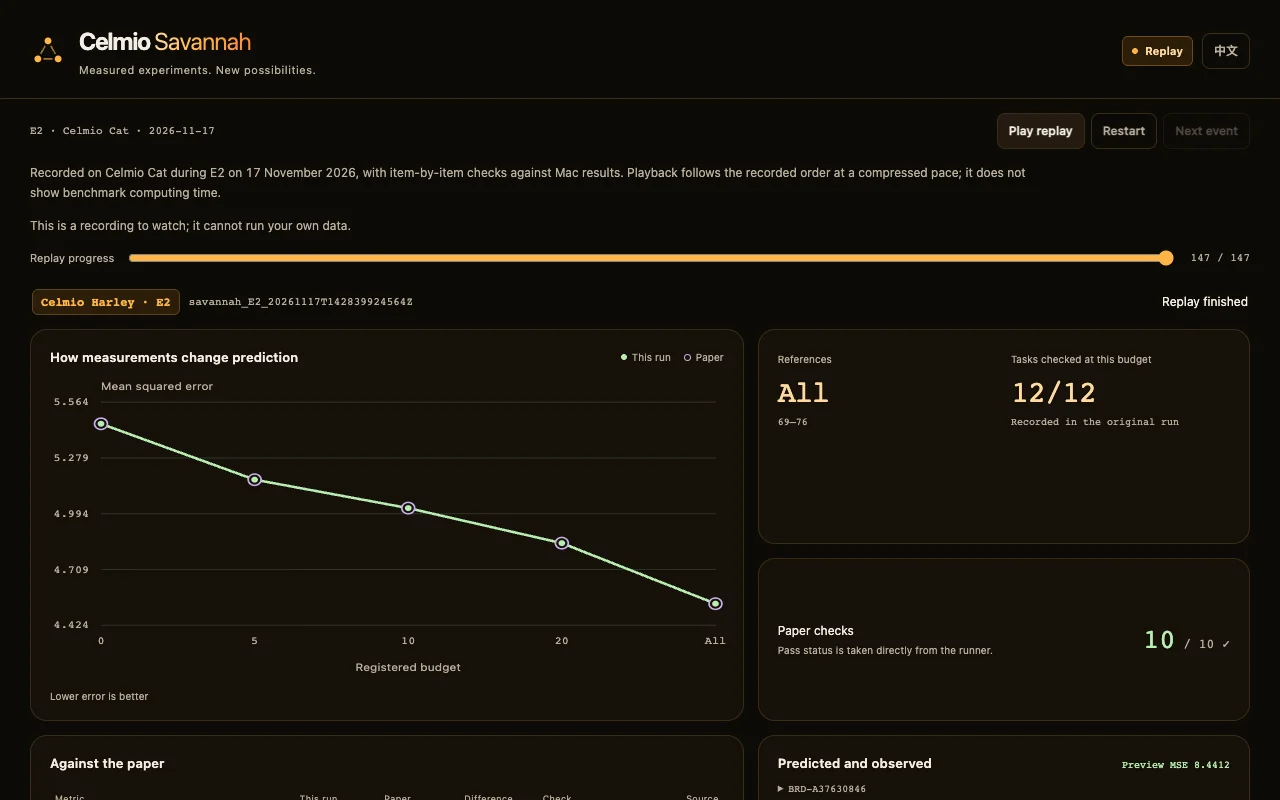
On screen: Five recorded reference budgets from 17 November 2026: 0, 5, 10, 20 and All. Mean squared error and the recorded time for each budget appear in sequence.
Mean squared error (MSE): lower is better. Time is the total for 12 tasks, including reference transfer and checking. Recorded checkpoints only; no interpolation of errors or times.
185.4–199.4 s
On screen: The offline results from 18 November 2026. All 106 Celmio Harley checks appear item by item, ending at 106 / 106.
Each item is shown at the registered precision. Neural-network baselines rescore the study’s archived predictions on Cat.
199.4–205.4 s
On screen: The Mac / Cat comparison verified on 17 November 2026. Both show the same registered metrics, a complete 106 / 106 check, and an 8-item excerpt side by side.
Same registered precision. Results only; no runtime comparison.
205.4–215.4 s
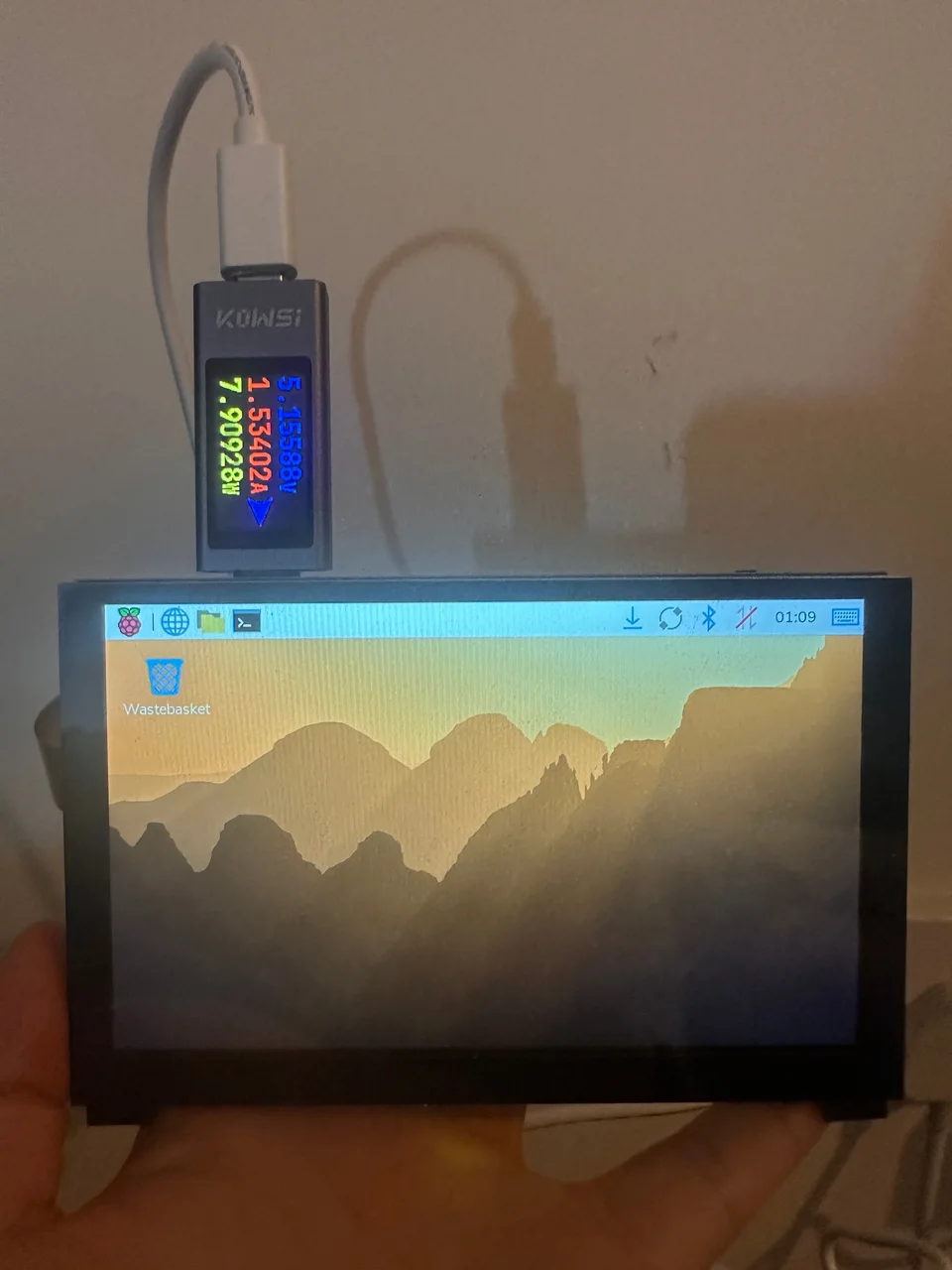
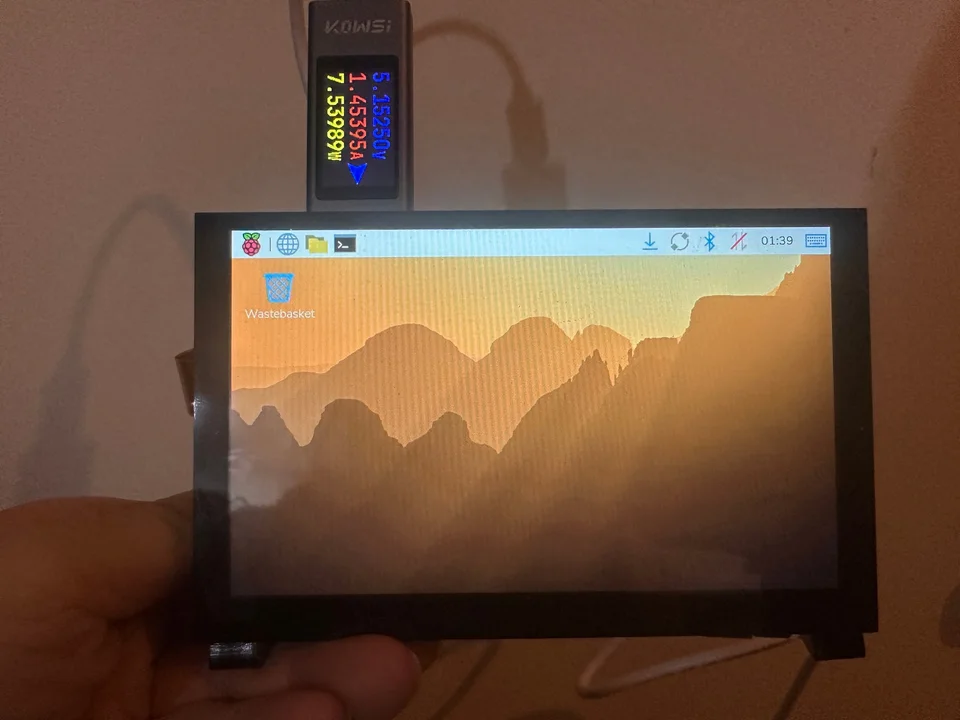
On-screen card: Whole device, computing offline: about 8 W.
7.90928 W · 5.15588 V · 1.53402 A; photo time: 2026-11-18 01:09:22.477 UTC.
7.53989 W · 5.15250 V · 1.45395 A; photo time: 2026-11-18 01:39:01.655 UTC.
4-thread offline run · 18 Nov 2026 · Instantaneous power, not average power or total energy.
215.4–223.4 s
Closing card: That's Celmio Cat: a mini box with a memory.
Want one? Come and find us.
Music: “Mindscapes” by Jesús Diestre (Muted Symphony), CC BY 4.0, creativecommons.org/licenses/by/4.0. Excerpt, volume adjusted.
223.4–227.4 s
Cover image: Celmio Cat.
CELMIO CAT
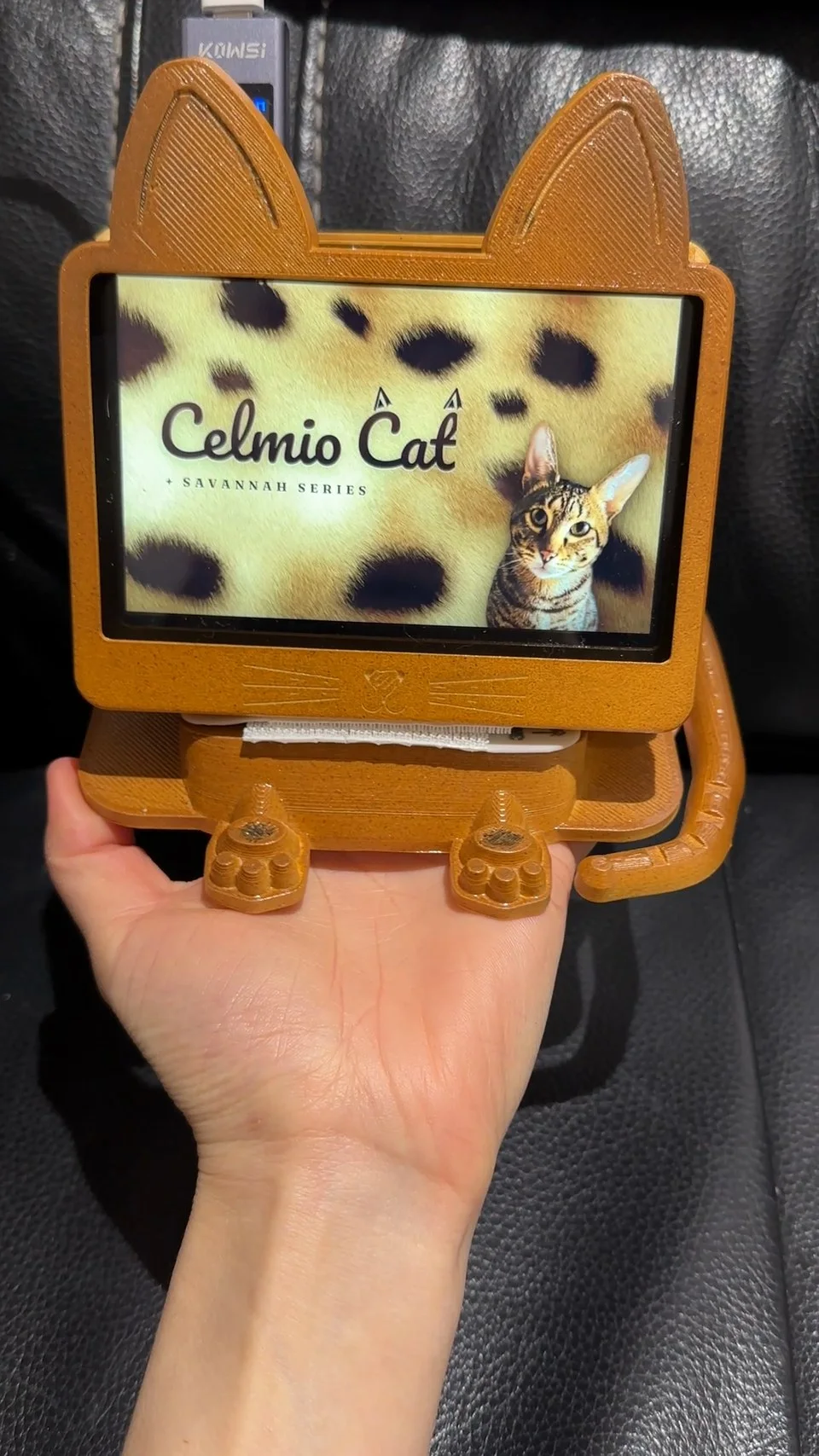
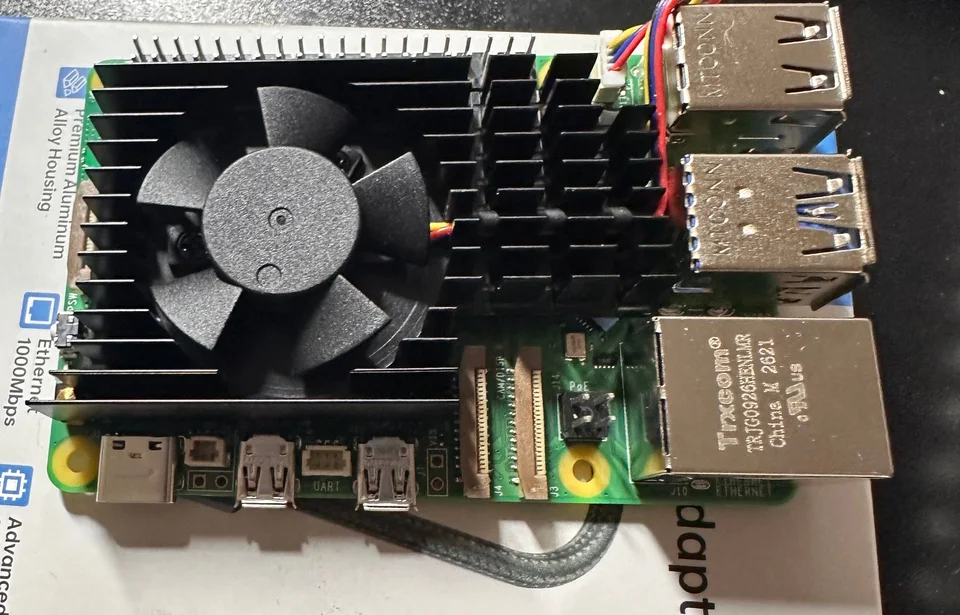
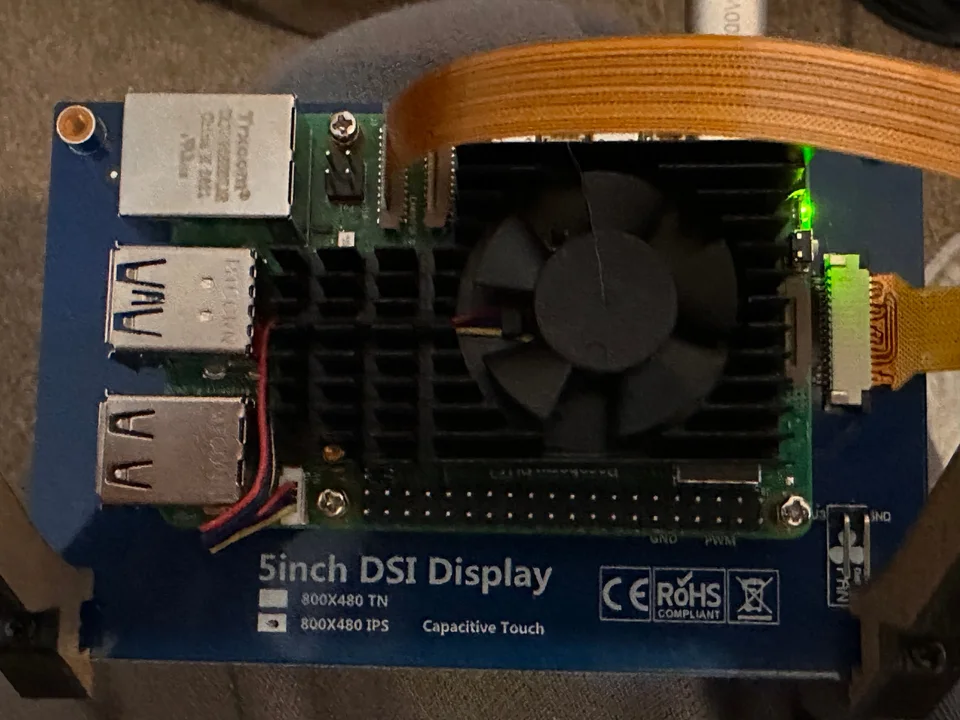
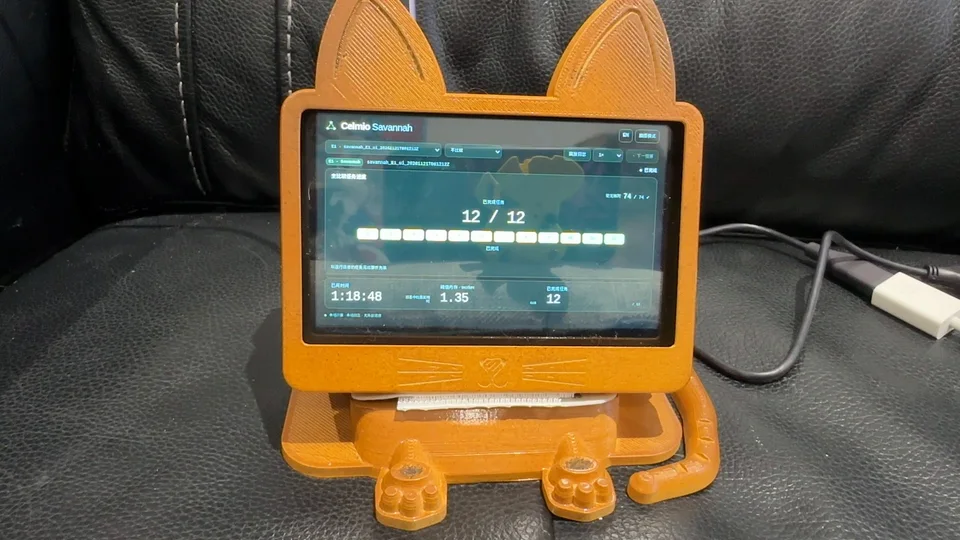
Celmio Cat is our own Celmio device: a Raspberry Pi 5 with a 5-inch screen and the software and model already installed. Computation and records stay on Cat, and it runs offline. This is the device filmed in the demo above.
The software and model are already on Cat. You do not need to set up the environment.
On the same configuration, all 106 Celmio Harley numbers matched. The main Celmio Harley results took about 80 minutes, and it also runs offline.
Progress and results appear directly on Cat’s screen.
ON YOUR COMPUTER
Open a browser on a computer on the same network to see the same interface as Cat’s screen: predictions and error curves update with every step.
Your computer only shows the picture. Computation and records stay on Cat, without going through our website. Cat can run offline.
No Cat yet, but want a look? Here is a replay of a real Cat run.
A REAL RUN, REPLAYED
Loading replay…
These are real records from Celmio Cat’s E2 measurement-budget run on 17 November 2026. That run also compared each item with the Mac, so it took longer than an ordinary run; time is compressed in the replay. See the measured records below for formal timings.
A replay is a record to watch. It cannot run your own data.
MEASURED RECORDS
Celmio Cat is a Raspberry Pi 5 (8 GB) with a 5-inch screen. These are the records from its final complete test series, 16–18 November 2026.
The main Celmio Harley results were computed again on the Raspberry Pi and compared with the Mac results item by item. All 106 Celmio Harley numbers matched; across 292 predictions, the largest difference from the Mac was less than one trillionth.
16–17 November 2026 · Record
savannah_E1_20261116T235739254554Z
In a new cell type, we measured 0, 5, 10, 20 and all references to see how the error changed. All 10 Celmio Harley budget-curve numbers matched.
17 November 2026 · Record
savannah_E2_20261117T142839924564Z
About 80 minutes for the main Celmio Harley results. Peak memory for the computation was under 1.5 GB. It also finished with a 1.5 GB limit; 1 GB was not enough. It finished offline too. Whole-device power was about 8 watts while computing and about 3.5 watts at idle.
17–18 November 2026 · Normal, offline, 1.5 GB limit and single-thread runs all passed.
The memory limit applies to the experiment itself. We have not tested a board with 2 GB of RAM. Power figures are meter readings; total energy for a complete run was not measured.
NEXT In progress
Today’s Cat can run Celmio Harley’s main results offline, start to finish. Cat 2.0 is its next version, with three goals:
Plug and play: switch on the power and it starts by itself, without another computer.
Once new experimental data has been processed, Cat keeps it. The goal is better predictions as its memory grows.
Put new data in and Cat processes it without a network connection. Data and memory stay in the box.
We have set Cat 2.0 a 30-day challenge: run offline for 30 days and see whether its predictions improve with use. We will publish the rules before it starts, and share the results here, good or bad.
Want to hear about Cat 2.0 first? Get in touch →